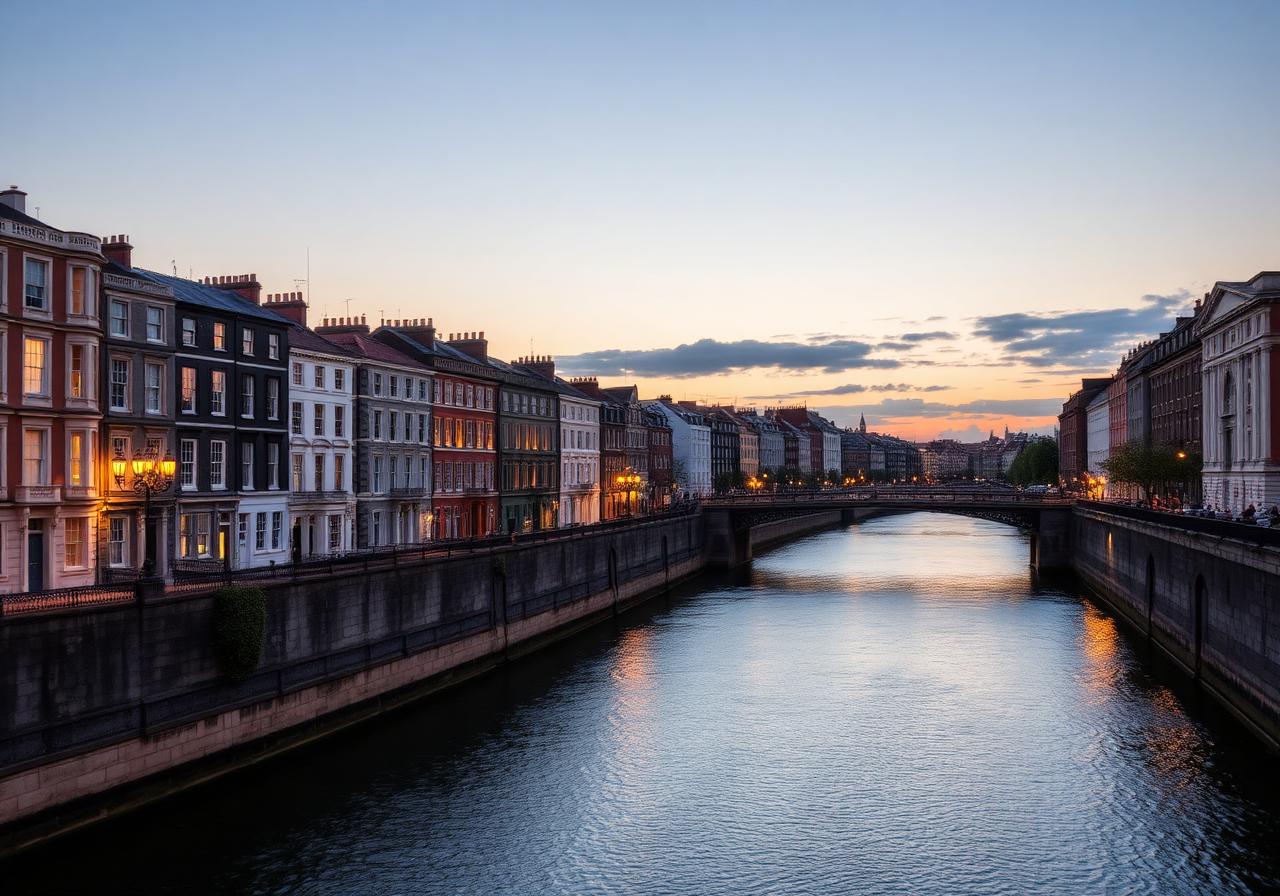
The heavy brass knocker on the door of 1 Merrion Square North rings with the same authoritative thud today as it did in 1855. Behind these red bricks, the young Oscar Fingal O'Flahertie Wills Wilde was raised in a household defined by intellectual eccentricity and social ambition. To walk Dublin’s southside squares is to move through a geography of genius, where the rigid symmetry of Georgian architecture provides the backdrop for a history of poetic rebellion. This route follows the ghosts of the Irish Literary Revival across cobblestones and through wrought-iron gates, tracing the specific corners where Wilde and Yeats found their voices.
The Clinic and the Salon at No. 1 Merrion Square
The trail begins at the corner of Merrion Square North and Clare Street. Sir William Wilde, Oscar’s father and a leading ear and eye surgeon, ran his practice from the ground floor, while Lady Jane "Speranza" Wilde hosted one of the city's most formidable literary salons upstairs. This was not a quiet domestic home; it was a sensory overload of occultism, nationalist politics, and classical Greek study.
The exterior remains a pristine example of Georgian restraint: look for the fanlight window above the door—a classic Dublin feature designed to illuminate the hallway with natural light before the advent of gas lamps. Just outside, the corner of the park holds the celebrated statue of Oscar Wilde, sculpted by Danny Osborne. Finished in multi-coloured stones—green nephrite jade from Canada, pink thulite from Norway, and blue pearl granite—the sculpture captures Wilde in a state of characteristic duality. He looks simultaneously toward his childhood home and the Dublin National Gallery, his face split between a smirk and a look of profound melancholy.
The Hidden Archives of the North Side
Moving east along the north side of the square, the architecture demands a slower pace. The houses here are famous for their "Dublin Doors," painted in deep oxblood, forest green, and midnight blue. The iron boot-scrapers embedded in the stone steps serve as a physical reminder of the Victorian city's muddy streets.
At No. 42, the Irish Architectural Archive offers free entry to its gallery. While the primary draw is the rotating exhibit of blueprints and sketches, the building itself is the true exhibit. One can stand in the hallway and view the original mahogany joinery and the intricate stucco ceilings, known as Dublin Rococo. This is the interior aesthetic that shaped the sensibilities of the Protestant Ascendancy—the social class to which both Wilde and Yeats belonged, and which they would eventually both champion and critique.
Yeats and the Shadows of No. 82
While Wilde’s presence is flamboyant, W.B. Yeats’s connection to the square is more austere. At 82 Merrion Square, on the south side, the poet lived during his tenure as a Senator of the Irish Free State in the 1920s. It was here that he revised some of his most harrowing late poems, including sections of The Tower.
The atmosphere shifts on this side of the park. The houses are taller, the shadows longer. Stand outside No. 82 and consider the contrast between the rigid, ordered windows and the chaotic, mystical imagery Yeats conjured within. This was the era of the "Civil War" period, where Yeats lived behind shutters for fear of sniper fire, yet continued to host Monday evening gatherings for the Dublin intelligentsia. Across the street, the park railings are often hung with local artwork on weekends, a tradition that mirrors the public art spirit Yeats sought to foster through the nearby Abbey Theatre.
The Secret Flora of the Park Interior
Merrion Square Park was once a private enclosure for the residents of the surrounding townhouses. Today, it serves as an open-air museum. Beyond the Wilde statue, hunt for the "Oscar Wilde Pillars"—three stone plinths covered in the author's most famous aphorisms, etched in his own handwriting.
The botanical choices in the park are deliberate. Look for the white lilies and the rows of hydrangeas, flowers frequently referenced in Aestheticist poetry. In the centre sits the Rutland Fountain, an 18th-century monument designed to provide water for the city's poor. It serves as a reminder that the grandeur of the square was always mirrored by the stark poverty of the nearby tenements—a divide that informed Wilde’s socialist essays and Yeats’s anxieties about a "changing Ireland."
The National Gallery and the Yeats Collection
The trail concludes at the National Gallery of Ireland on Merrion Square West. Entry remains free for the permanent collection, which contains the definitive visual record of this literary era. Head directly to the Yeats Room. Here, the focus shifts to Jack B. Yeats, the poet’s brother and Ireland's most celebrated painter.
His works, such as The Liffey Swim and The Flower Girl, capture the kinetic energy of Dublin life that the literary giants described in text. The gallery also holds the iconic portrait of W.B. Yeats by John Butler Yeats (the father). Seeing the family’s collective output in one room reinforces the idea that the Merrion Square circle wasn't just a collection of individuals, but a concentrated explosion of Irish creative identity.
If you go
Route: Begin at the Wilde Statue (Northwest corner of Merrion Square). Walk clockwise around the square, ending at the National Gallery of Ireland on Merrion Square West. Timing: Allow two hours for a leisurely circuit. The park gates open at dawn and close at dusk. Best day: Sundays often feature an open-air art market along the park railings. Coffee: Stop at The Wilde & Co on nearby Lincoln Place for a brief respite. Reading: Carry a copy of The Picture of Dorian Gray or Yeats’s The Winding Stair to read on the park benches; the descriptions of "London" interiors in Wilde’s work are almost entirely lifted from his Dublin upbringing.