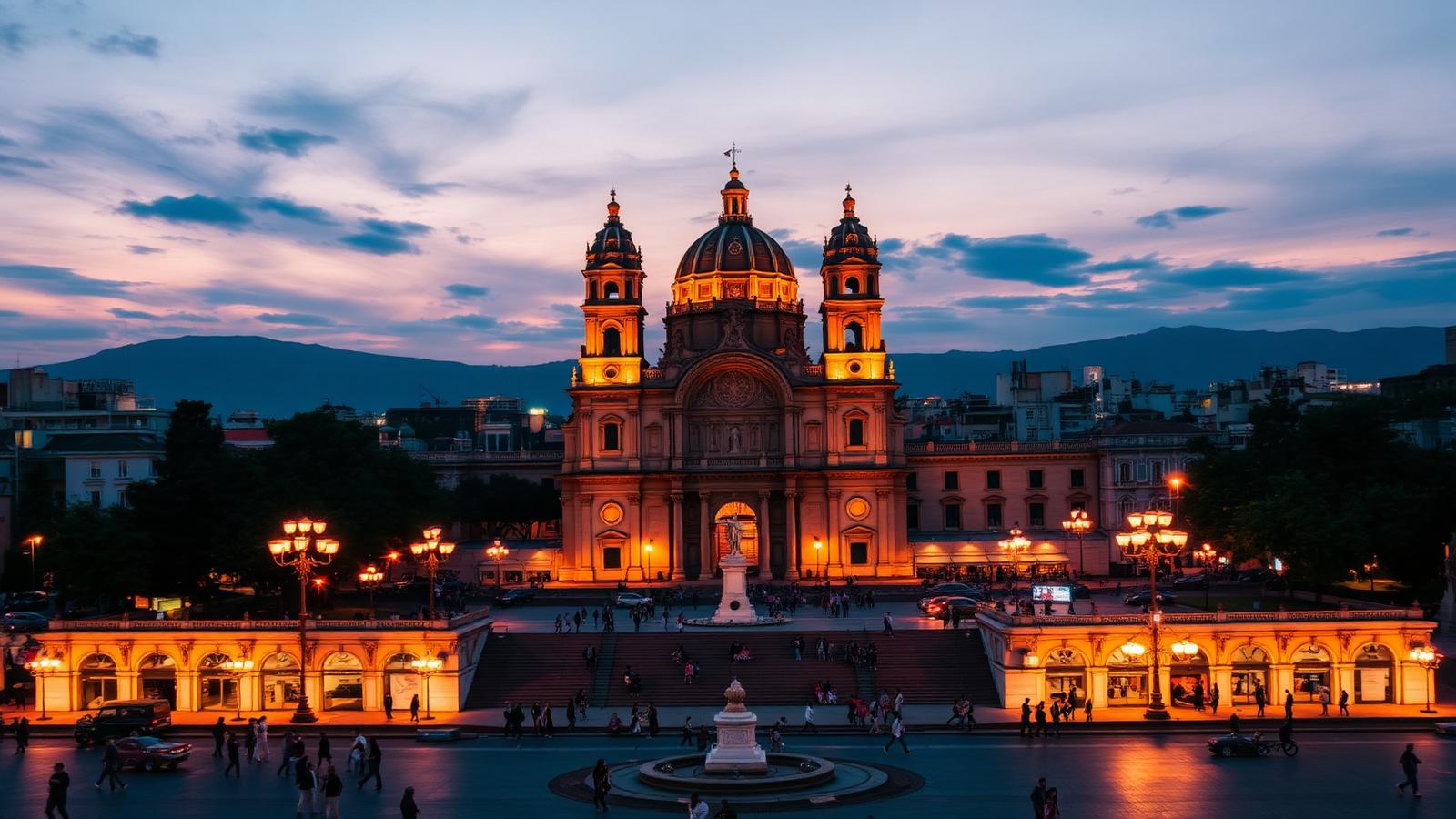
Most people cross the intersection of Avenida 5 de Mayo and Eje Central Lázaro Cárdenas with their eyes fixed on the white marble froth of the Palacio de Bellas Artes. They ignore the hulking grey stone fortress directly opposite. This is the headquarters of the Banco de México, the guardian of the peso and a bastion of institutional silence. For decades, its heavy bronze doors remained shut to the public, concealing a cathedral of Art Deco design and revolutionary murals behind a facade of fiscal austerity. To step inside is to trade the chaotic roar of Mexico City traffic for a hushed, climate-controlled world of black marble, polished brass, and the smell of old money.
The Architecture of Stability
Originally constructed as the headquarters of the Mutual Life Insurance Company of New York in 1905, the building was reimagined in the 1920s by architect Carlos Obregón Santacilia. His mission was to project the image of a modern, stable Mexico following the upheaval of the Revolution. He stripped away the ornate Porfirian trimmings, opting instead for the streamlined geometry of Art Deco.
The lobby remains a masterclass in the style. Enormous black granite columns rise toward silver-leaf ceilings, while geometric grilles and massive clocks—manufactured by the New York firm Self Winding Clock Co.—tick with terrifying precision. Everything here is meant to feel permanent. The floor consists of polished volcanic stone, reflecting the glow of bespoke lamps that look like frozen lightning bolts. It is a space designed to intimidate as much as to impress, a temple where the liturgy is the exchange rate.
Fermín Revueltas and the Stained-Glass Sky
The crowning jewel of the main hall is not made of stone or paper, but of light. In 1929, Fermín Revueltas—a key figure in the Mexican Muralist movement alongside Rivera and Orozco—was commissioned to design the stained-glass windows that flank the central nave. These are not the saints and martyrs of the nearby Metropolitan Cathedral. Instead, Revueltas depicted the modern deities of the 1920s: industry, agriculture, and commerce.
Gaze upward at the "Allegory of the Production," where bold, Cubist-influenced lines render gears, cogwheels, and muscular laborers in shades of amber, emerald, and deep indigo. Unlike the sprawling, outdoor frescoes found at the Secretaría de Educación Pública, these works are contained within the rigid frames of the windows, forcing a tension between the revolutionary fire of the art and the conservative structure of the bank. The light filtering through the glass bathes the tellers' desks in a shifting palette of technicolor, a reminder that the bank’s wealth is built on the physical toil of the people depicted in the panes.
Into the Vault: The Money Museum
In 2021, the bank finally yielded to curiosity and opened its "Museo Banco de México" within the ground floor and basement levels. This is where the clandestine nature of the institution becomes tactile. A spiral staircase leads visitors down into the original vault, a space encased in two-metre-thick reinforced concrete and steel.
The main vault door is a terrifying piece of machinery, a circular mass of shivering steel bolts and clockwork mechanisms. Inside, the exhibition goes beyond dull economics. You can see the evolution of Mexican currency, from the "hacienda tokens" used to exploit farmworkers to the beautifully intricate 19th-century banknotes printed by the American Bank Note Company. The display includes rarities like the "Revolutionary Pechereques" and currency issued by Pancho Villa’s rebel army. It provides a visceral timeline of Mexico’s history told through the things people held in their pockets while the wind of the Revolution blew outside.
The Murals of the Mezzanine
While the stained glass captures the eye, the mezzanine level houses a series of often-overlooked murals that bridge the gap between financial theory and human reality. Here, the imagery shifts toward the more traditional Mexican Muralism aesthetic, though tempered for a corporate audience.
Revueltas and his contemporaries used these spaces to tell a story of a country in transition. Look for the representations of the "three pillars" of the Mexican economy—silver, oil, and corn. The silver mining scenes are particularly evocative, displaying the dark, subterranean grit of Taxco and Pachuca. These paintings act as a conscience for the building; even in the heart of the national treasury, the artists ensured that the primary sources of Mexican wealth—the soil and the subsoil—were never forgotten by the men in pinstriped suits.
A Hidden View of the Madero
Exiting the bank offers one final secret. From the elevated perspective of the entrance stairs, you gain a unique vantage point down Calle de Madero, the city’s busiest pedestrian artery. From here, you can see the tiled facade of the Casa de los Azulejos and the dizzying height of the Torre Latinoamericana framed by the bank’s heavy Art Deco portals. It is the best place in the Centro Histórico to witness the collision of three centuries: the colonial blue-and-white tiles, the 1920s financial power, and the 1950s steel skyscraper. For a few moments, the bank doesn’t feel like a fortress of finance, but a silent observer of a city that never stops moving.
If you go
The Museo Banco de México is located at Avenida 5 de Mayo 2. Entrance is free, but you must book a time slot in advance via the bank's official website (museobancodemexico.mx). The museum is open Tuesday to Sunday, 11:00 to 17:00. No bags or cameras are allowed inside the main vault area; free lockers are provided at the entrance. The nearest Metro station is Bellas Artes (Blue and Green lines). Wear comfortable shoes, as the guided path through the vaults and mezzanine covers significant ground.