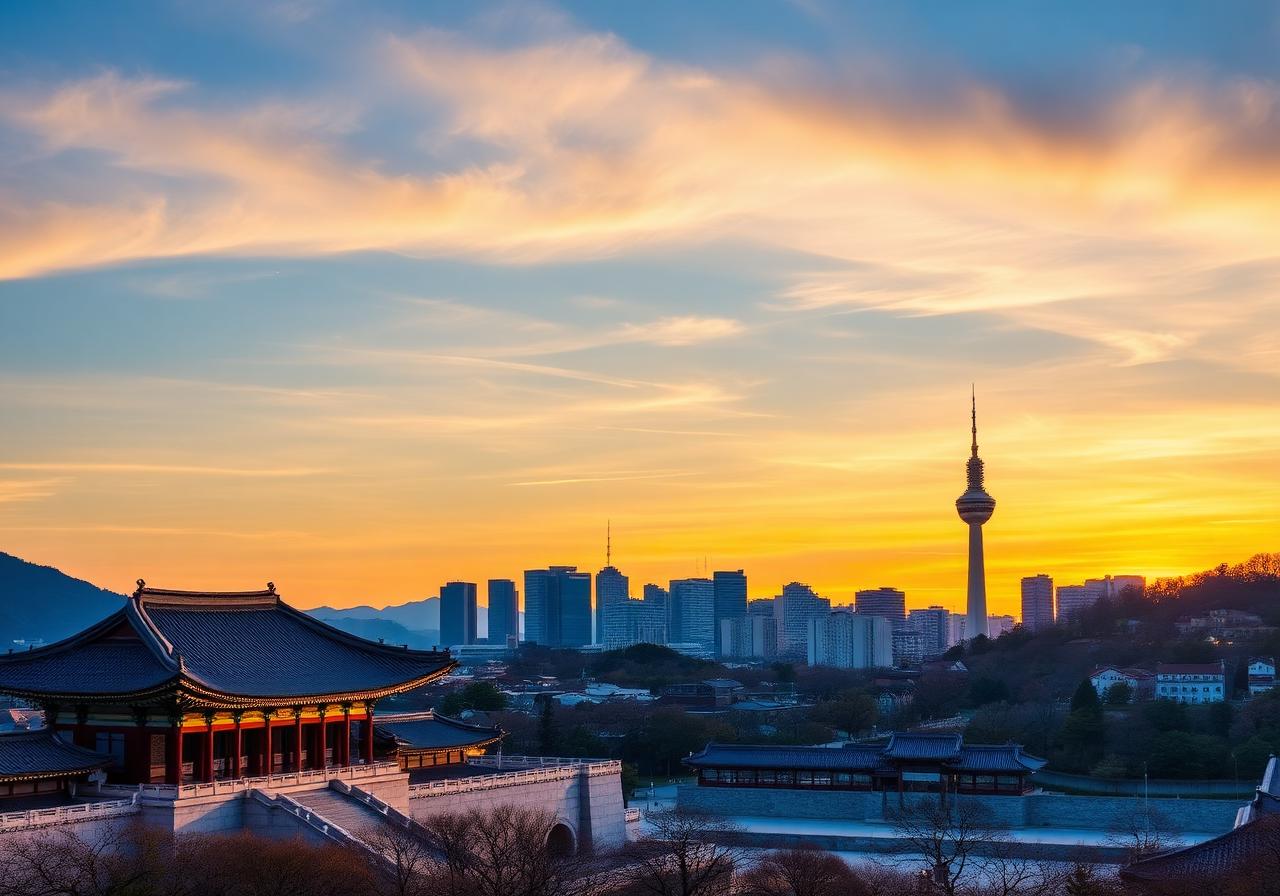
The cold in Seoul behaves differently than in London or New York. It is a dry, biting Siberian wind that rattles the glass of the Lotte Plaza Hotel and turns the breath of commuters into thick plumes of steam. But at the foot of the Seoul City Hall, beneath the glow of a colossal LED-wrapped fir tree, the air smells of caramelising sugar and toasted rice. This is Seoul Square, the epicenter of the city’s winter transformation. While the aesthetic borrows from the European tradition—wooden chalets, twinkling lights, and evergreen wreaths—the palate is purely Korean. Here, the festive season is defined by Hansik (Korean food), where the traditional bratwurst is sidelined for something far more complex, spicy, and soul-warming.
The Hotteok Ritual at the City Hall Gates
The queue for hotteok (sweet syrupy pancakes) is often the longest at the market, snaking past the ice rink. Unlike the greasy, pre-frozen versions found in tourist hubs, the vendors at Seoul Square treat the dough like fine pastry. The exterior is fried in a shallow pool of oil until the yeast-raised dough turns a blistered, golden brown. Inside, a molten core of dark brown sugar, cinnamon, and crushed walnuts awaits.
For a refined take, look for the stalls specialising in ssiat hotteok. Originating from Busan but perfected here for the winter crowds, these pancakes are sliced open post-fry and stuffed with a handful of sunflower seeds and pumpkin seeds. The result is a textural masterclass: the crunch of the seeds cutting through the sticky, lava-like syrup. It is the definitive Seoul street snack, best eaten while standing near one of the standing heaters, shielding the paper cup from the wind.
Spiced Citrus and the Rise of Soju Vin Chaud
While Germany has its Glühwein, Seoul has reinvented the concept using the peninsula's bounty. The "Seoul Mulled Wine" found at the market’s beverage stalls is a hybrid of French technique and Korean harvest. Instead of heavy red wines, many vendors use a base of cheongju (clear rice wine) or a premium distilled soju, infused with yuja (yuzu) from the southern coast of Goheung.
The yuja adds a sharp, floral acidity that cuts through the sugar, further enhanced by thick slices of ginger and Korean cinnamon bark (gyepi). It is served in steaming paper cups, often with a dried persimmon slice floating on top. For those seeking something strictly traditional, seek out the sujeonggwa. This cold-weather punch is brewed from ginger and cinnamon, then chilled, but served warm at the markets to highlight its spicy, medicinal kick. It acts as a digestive palate cleanser between the heavier fried snacks.
Roasted Persimmons and the Smoke of the Gwanghwamun Fire
Walking toward the nearby Gwanghwamun gate, the scent shift is immediate. The sweet aroma of hotteok gives way to the earthy, wood-fired smell of gun-bam (roasted chestnuts) and gun-goguma (roasted sweet potatoes). In Seoul, these aren't just snacks; they are cultural touchstones of the winter season.
The chestnuts are scorched in rotating metal drums until the shells split to reveal a buttery, yellow interior. Beside them, the sweet potatoes are roasted in their skins until the natural sugars caramelise into a sticky, jam-like consistency. At Seoul Square, look for the vendors selling godjigot—dried persimmons that have been lightly toasted over a flame. The heat softens the chewy, sundried fruit, turning it into a natural confection that tastes of honey and smoke. It is a stark, elegant alternative to the over-processed chocolates of Western markets.
Tteokbokki and the Savoury Counterpoint
The festive cold demands heat that goes beyond temperature. To balance the sweetness of the market’s pastries, the bunsik (snack food) stalls offer tteokbokki. These cylindrical rice cakes are simmered in a thick, vibrant red sauce of gochujang (fermented chilli paste) and gochugaru (chilli flakes).
The Seoul Square iteration often includes a seasonal twist: don-gasu (pork cutlet) toppings or a blanket of melted mozzarella to mellow the spice. However, the true connoisseur looks for the eomuk-tang (fish cake soup). The fish cakes are skewered in long, wavy ribbons and submerged in a broth of dried kelp and anchovies. Most vendors provide a small cup of the broth for free with any purchase; it is the ultimate "hidden" menu item—a salty, umami-rich liquid that warms the chest instantly and provides the necessary stamina to continue browsing the handicraft stalls.
Cultural Craft and the Souvenir of Seoul
Beyond the food, the market at Seoul Square is a showcase for contemporary Korean craft that eschews the usual plastic baubles. Modern Hanbok designers sell heavy, quilted winter jackets (som-ot) and silk scarves dyed with natural indigo and persimmon juice.
Look for the stalls from the Bukchon Hanok Village artisans. Here, you can find hand-poured candles scented with sandalwood and mugwort, or delicately carved wooden ornaments shaped like the Haechi—the mythical lion-like creature that serves as the guardian of Seoul. Unlike the mass-produced trinkets of many European markets, the offerings here are curated to reflect the city’s design-forward identity, blending the ancient Ming-dynasty aesthetic with the sleek minimalism of modern Gangnam.
If You Go
Dates and Times: The Seoul Square Christmas Market generally runs from mid-December through to the end of the month, typically opening at 4:00 PM and closing at 9:00 PM. The lights are most impressive after 6:00 PM.
Getting There: Take the Seoul Subway Line 1 or 2 to City Hall Station. Exit 5 leads directly into the square.
Payment: While most vendors take international credit cards and T-money cards, keep a small amount of cash (10,000 KRW notes) for the smaller, traditional chestnut and sweet potato carts which may not have card terminals.
What to Wear: The temperature can drop to -10°C. Thermal layers (Uniqlo’s Heattech is the unofficial uniform of Seoul) and a heavy padded parka are essential. Don’t forget a pair of touch-screen gloves so you can navigate the market’s digital maps without losing a finger to the frost.