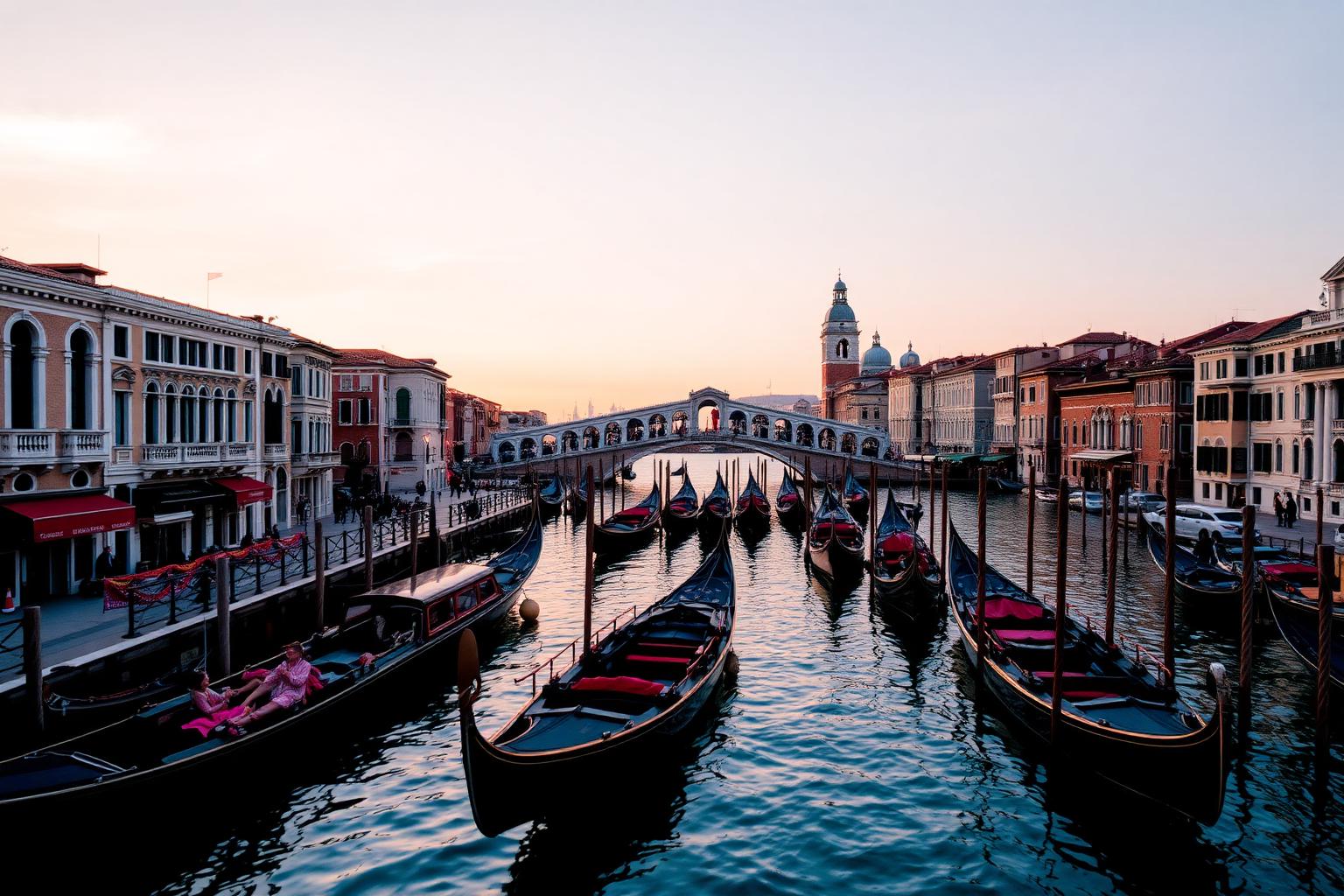
The mist sits heavy on the Rio di Palazzo, blurring the edges of the 16th-century Istrian stone until the water and the walls become one shade of charcoal. In the sestiere of Castello, specifically within the labyrinthine reach of the Campo Santa Maria Formosa, the usual tourist trail of glass trinkets and mass-produced lace dissolves. Here, behind the heavy timber doors of the Palazzo Loredan Grifalconi, lies a sensory vault that feels less like a shop and more like an aristocratic inheritance. This is the world of Roberta di Camerino—a name that, despite the Hollywood moniker, belongs to the late Venetian couturier Giuliana Coen. It is a place where the 1950s are preserved not in amber, but in hand-woven velvet and Murano glass beads.
The Architect of the Trompe l’Oeil
Giuliana Coen did not design clothes; she engineered illusions. In 1943, fleeing to Switzerland to escape fascist persecution, she began crafting handbags to survive. By the 1950s, she had returned to Venice, winning the Neiman Marcus Fashion Award and outfitting Grace Kelly. The archive at the Roberta di Camerino atelier is the ultimate pilgrimage for those hunting the original Bagonghi—the domed, doctors-style handbag that redefined luxury long before the era of the 'it' bag.
The hallmark of the house is trompe l’oeil. Coen’s genius lay in printing collars, buttons, and belts onto flat surfaces of silk and jersey, creating three-dimensional depth where none existed. Walking through the quiet rooms of the Palazzo, one finds evening bags from 1956 where the "buckle" is actually a masterful weave of Soprarizzo velvet, a technique involving two different heights of pile. There is a specific silence to these archives, punctuated only by the distant chime of the clock tower in St. Mark’s Square.
Hunting for Murano Glass and Velvet
While the flagship presence remains elevated, the real thrill for the collector is the secondary market and private appointments surrounding the Santa Maria Formosa area. The archive contains waistcoats that feel heavy with history, constructed from velvets woven on 18th-century looms by the Bevilacqua family. These are not factory-made garments; they are artifacts of a dying industry.
The hardware is where Venice truly reveals itself in the silk. Coen turned to the glass masters of Murano to create bespoke closures. If you find a vintage Roberta piece from the late fifties, the "jewel" on the clasp is often a hand-blown bead or a shard of millefiori glass, specifically commissioned to match the dye of the velvet. In the back rooms and specialised vintage boutiques nearby, such as L’Armadio di Coco on Calle de la Testa, one might stumble upon a 1960s jersey dress—the fabric so fluid it feels like mercury, printed with the signature "R" motif that predates the logos of Gucci or Fendi.
The Riches of the Campo Santa Maria Formosa
To understand the context of these garments, one must walk the Square. The Campo Santa Maria Formosa is one of the few places in Venice where the scale of the architecture matches the ambition of the silk. It is surrounded by the Palazzo Querini Stampalia and the Church of Santa Maria Formosa, whose white facade reflects the midday light back onto the polished pavements.
In the small, unmarked workshops scattered along the narrow calli leading toward the Rialto, the spirit of Coen’s craft persists. Collectors should look for the 1950s waistcoats—often found in deep bordeaux or forest green. These pieces were designed to be worn at the Harry’s Bar of the era, styled with a crisp white shirt and a sense of architectural nonchalance. They are stiff, structured, and entirely unapologetic.
Sourcing the Authentic Archive
Authenticating a piece from the Coen era requires a tactile education. The genuine 1950s velvet is cool to the touch and possesses a matte finish that modern synthetics cannot replicate. When visiting the estate or curated retailers like Vintageria in the Cannaregio district, focus on the "Caravel" bag. This structured tote, famously favoured by the Empress of Japan, features a brass frame that clicks with a precision found only in mid-century Italian metalwork.
The colours are equally telling. Coen’s palette was borrowed from the Venetian Masters—Tizian reds, Tintoretto golds, and the deep, ink-wash blues of Veronese. To find a 1970s silk scarf in the archive is to see a map of the city’s canals rendered in geometric abstraction. These are pieces of the city that you can fold into a suitcase and take home.
The Legacy of the Countess
Giuliana Coen, though a master of branding, lived the life of the Venetian elite. Her work was a rebellion against the grey austerity of post-war Europe. Today, the archive represents the last vestige of a time when a handbag was constructed with the same rigour as a cathedral.
The "Countess’s Attic" is not a dusty metaphor; it is the reality of Venetian fashion heritage. Many of the finest pieces from the 1950s and 60s are still held in private collections within the city, occasionally surfacing in high-end consignment shops or via private viewings at the Palazzo. To wear a piece of Roberta di Camerino is to participate in a visual trick—a play of light and fabric that perfectly mirrors the shimmering, deceptive surfaces of the Venetian lagoon.
If you go
Atelier Roberta di Camerino: Located at Palazzo Loredan Grifalconi, Castello 6059. Appointments are often required to view the primary archives and historical collections.
Vintageria Venezia: Situated on Calle de l'Oca 4310. An excellent spot for sourcing 1970s Roberta accessories and silk scarves that have been rigorously authenticated.
L’Armadio di Coco: Located at Castello 6029b. A curated space that frequently stocks mid-century Venetian couture, including the rare trompe l'oeil jersey pieces.
Travel Tip: When inspecting vintage velvet, check the 'bite.' High-quality Soprarizzo velvet from the 1950s should show a distinct contrast between its cut and looped piles. If the surface is uniform, it is likely a later reproduction.