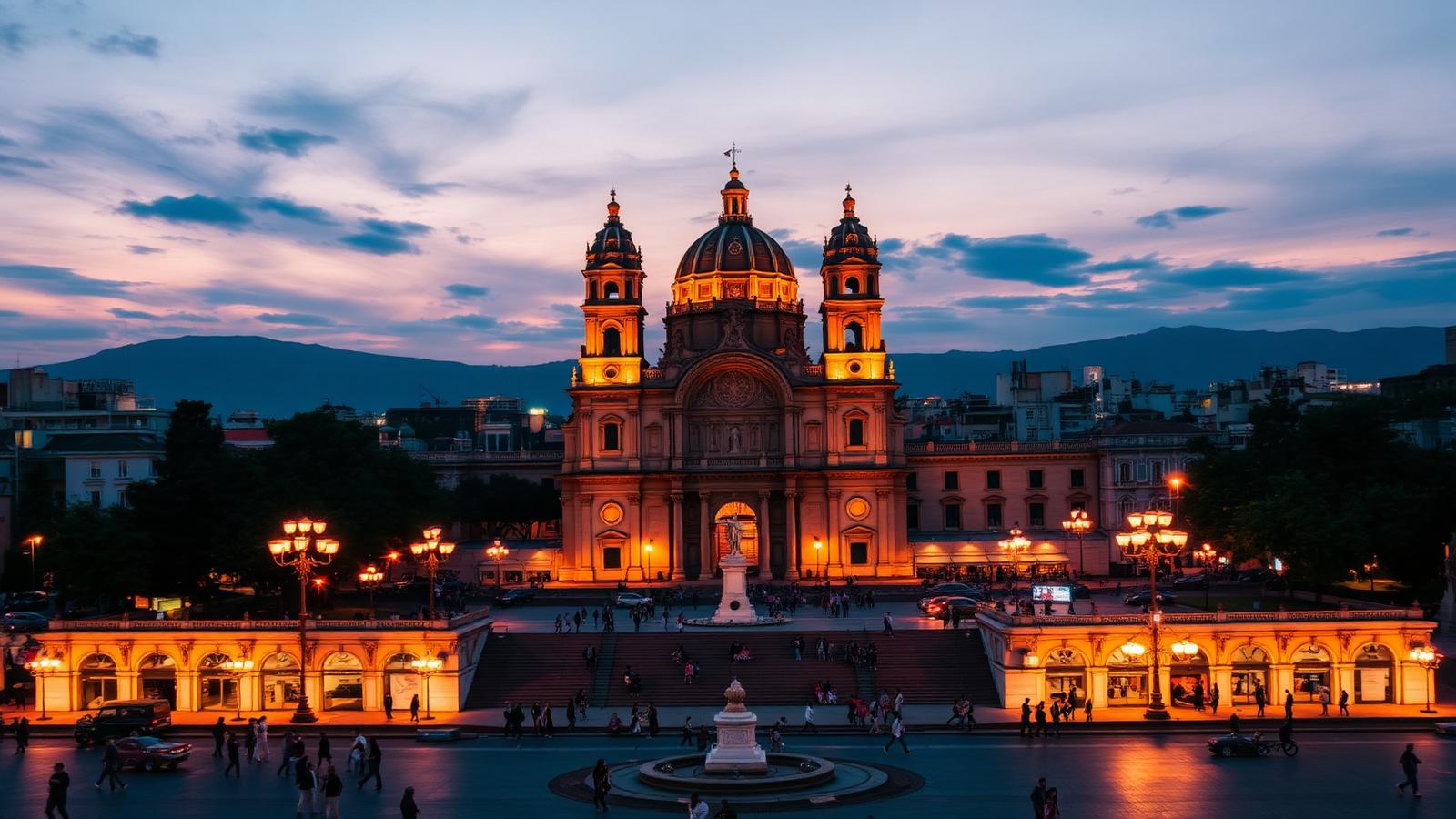
The afternoon sun in Mexico City has a specific weight when it hits the Bosque de Chapultepec. It filters through the canopy of ahuehuete trees—some centuries old—to illuminate a structure that feels less like a building and more like a mountain range fashioned from chiselled stone. This is the Museo Tamayo Arte Contemporáneo, a low-slung fortress of crushed marble and concrete that sits at the intersection of pre-Hispanic monumentality and 20th-century futurism.
While the neighboring National Museum of Anthropology draws the massive crowds for its Aztec sun stones, the Tamayo offers a quieter, sharper thrill. It is a monument to the personal crusade of Rufino Tamayo, the Oaxacan painter who spent his life warring against the didactic, political murals of Diego Rivera and David Alfaro Siqueiros. Tamayo wanted Mexico to look outward, to the international avant-garde. To house his collection of PICASSO, Rothko, and Bacon, he demanded a space that was as radical as the art inside.
The Architecture of the Crushed Stone
Completed in 1981, the museum is the magnum opus of architects Teodoro González de León and Abraham Zabludovsky. It is the definitive example of Mexican Brutalism—a style that stripped away the slick glass of International Modernism in favour of something tactile and tectonic.
The exterior walls are not poured smooth. Instead, the concrete was hand-hammered with chisels to reveal an aggregate of marble and crushed stone. This texture mimics the volcanic rock of the Pedregal region south of the city, grounding the building in the local earth even as its cantilevered slopes reach for the sky. There are no traditional windows on the primary facade; instead, deep recesses and skylights funnel natural light into a series of interconnected, modular galleries. Walking around the perimeter on the Paseo de la Reforma side, the building appears to sink into the park’s berms, disappearing into the greenery before re-emerging as a defiant, grey prow.
Tamayo’s Rebellion Against the Muralists
Rufino Tamayo was a man out of time. During the 1930s and 40s, when the "Big Three" muralists were painting grand historical narratives of class struggle, Tamayo was obsessing over the texture of watermelons and the cosmic geometry of pre-Columbian ceramics. He felt the state-sponsored "Mexicanness" of his peers was a provincial trap.
His collection, which he donated to the Mexican people, is a testament to this rebellion. The permanent collection includes over 300 works that bridge the gap between European Modernism and American Abstract Expressionism. Standing in the central atrium, one can find Fernand Léger’s Les Quatre Personnages or Francis Bacon’s haunting Figure with Monkey. These aren't just legacy pieces; they represent a moment when Mexico City positioned itself as a global node for the avant-garde. The museum ensures that the dialogue between local tradition and international abstraction remains open and unresolved.
The Light-Filled Inner Sanctum
The interior of the Tamayo is a masterclass in spatial control. There are no corridors; the galleries flow into one another via ramps and half-levels, a layout that encourages a nomadic, non-linear exploration. The central courtyard is the building's heart, topped by a complex system of wooden beams and glass that allows the shifting CDMX clouds to dictate the mood of the art.
On a clear day, the shadows cast by the roof structure create a second, ephemeral architecture on the concrete floors. It is in these interstitial spaces—the stairwells and transition zones—that the genius of González de León is most apparent. He designed the building to be "unwrapped" by the visitor. As one moves through the collection of Jean Dubuffet or Max Ernst, the park outside is occasionally revealed through strategically placed floor-to-ceiling glass slits, reminding the viewer that they are inside a garden within a city.
Sound, Space, and the Sunday Crowd
While many international galleries feel like aseptic white cubes, the Tamayo is a social organism. The museum’s programming leans heavily into performative and sound art, often utilising the resonant acoustics of the concrete halls. It is not uncommon to find a sound installation by Tarek Atoui or a screening of an experimental film by Apichatpong Weerasethakul.
On Sundays, the museum takes on a different energy. Entry is free for Mexican residents and foreign residents with credentials, turning the site into a high-concept community centre. The museum shop is arguably the best in the city, eschewing cheesy souvenirs for high-end design objects and rare monographs. Meanwhile, the restaurant, Restaurante Tamayo, serves some of the most refined chilaquiles in the Bosque de Chapultepec on a cantilevered terrace that hangs over the forest floor. Sitting here with a café de olla, watching the joggers and the street vendors on the fringes of the park, the heavy concrete of the museum feels surprisingly light.
If You Go
Location: Paseo de la Reforma 51, Bosque de Chapultepec, Miguel Hidalgo, 11580 Mexico City.
Hours: Tuesday to Sunday, 10:00 to 18:00. Note that the museum is closed on Mondays.
Admission: Entry is approximately 85 MXN. However, entry is free for everyone on Sundays. Students, teachers, and seniors with valid ID enter free daily.
Transport: Take the Metro Line 7 to Auditorio or Metro Line 1 to Chapultepec. It is a 10-minute walk from either station through the woods.
Don't Miss: The "Tamayo Room," where a rotating selection of Rufino’s own large-scale canvases are displayed in a space specifically calibrated for their saturated, earthy pigments. After your visit, walk five minutes east to see the Monumento a la Patria for a direct contrast in architectural styles.