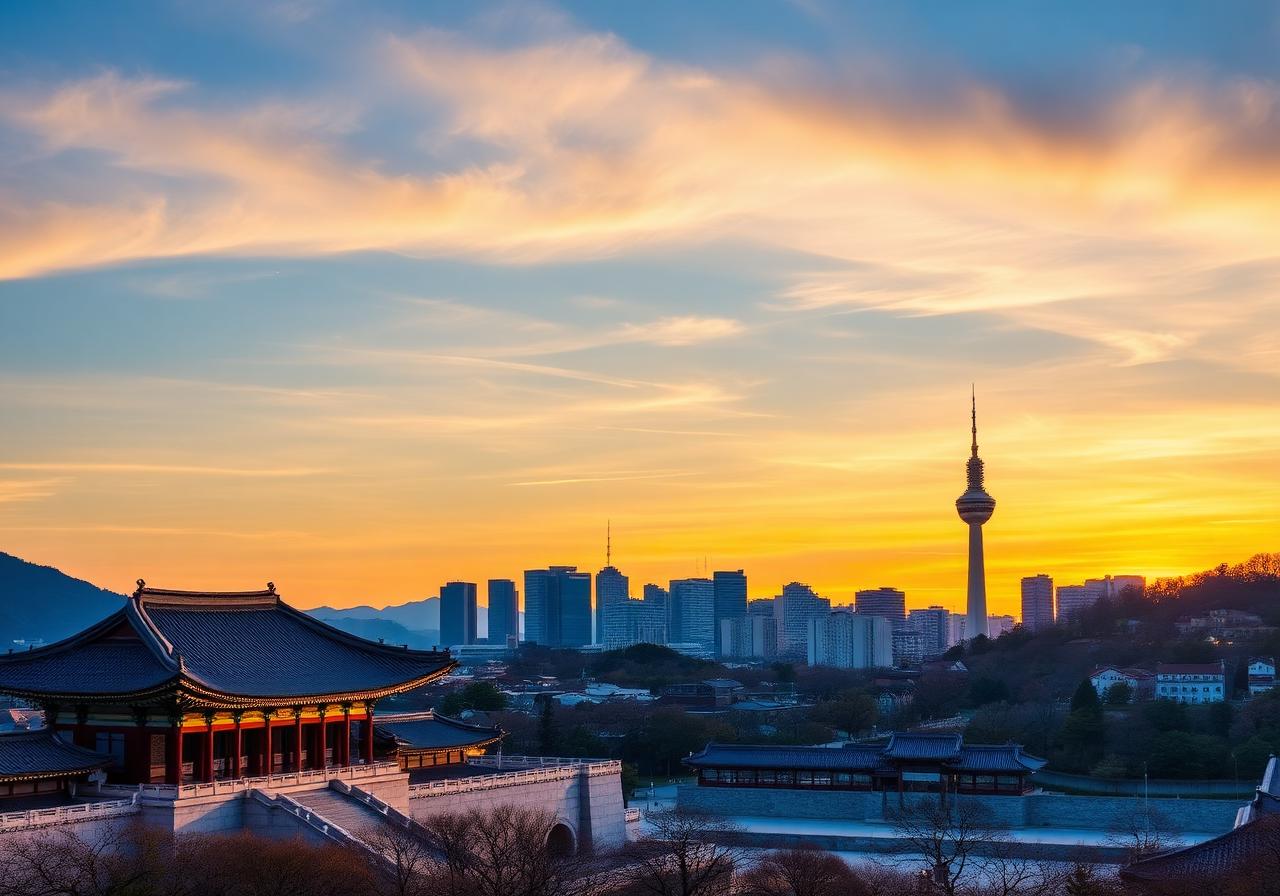
The grey granite of Gwanghwamun Square, usually a austere stage for political rallies and military parades, softens under the amber glow of several thousand bulbs as December arrives. To the north, the sloping black roofs of Gyeongbokgung Palace sit silhouetted against the dark mass of Bugaksan Mountain. To the south, the glass towers of the Jongno district shimmer. Between them, under the watchful bronze gaze of Admiral Yi Sun-shin, Seoul constructs a version of Christmas that feels spectacularly unique to the peninsula: a hybrid of a Bavarian village and a Joseon Dynasty festival.
The Luminescent Art of Hanji
While European markets lean heavily on fir boughs and tinsel, Gwanghwamun’s visual identity is defined by hanji—traditional Korean mulberry paper. Local master artisans spend months crafting massive, translucent lanterns that populate the square during the Seoul Lantern Festa, which runs concurrently with the market. These are not mere globes; they are life-sized depictions of 15th-century scholars, mythical haetae (lion-dog guardians), and intricate recreations of the royal procession of King Jeongjo.
The light produced by these paper sculptures is soft, organic, and diffusive, providing a stark aesthetic contrast to the sharp neon of the surrounding skyscrapers. Walking between the stalls, visitors pass under the "Tree of Life," a towering installation of LED branches that pulses in time to a soundtrack of reimagined Korean folk songs and orchestral carols. It is a masterful use of light as a structural element, turning a windy ceremonial plaza into an intimate, glowing corridor.
High-End Craftsmanship at the Night Market
The market avoids the common trap of mass-produced plastic trinkets. Curated by the Seoul Tourism Organisation, the stalls focus on the "Made in Seoul" label, championing artisans who blend contemporary design with ancient motifs. Look for bojagi (traditional wrapping cloth) reimagined as silk scarves, or ceramic cups fired in the Gyeonggi-do style but decorated with modernist geometric patterns.
Particular attention should be paid to the stationery stalls. Korea’s obsession with high-quality paper goods is on full display here; expect to find hand-pressed Christmas cards featuring woodblock prints of the Seoul city gates and delicate brass bookmarks shaped like Ginkgo leaves. These aren't just souvenirs; they are pieces of functional art that reflect the square’s proximity to Insadong, the city’s historic art quarter.
A Culinary Collision of East and West
The scent of the Gwanghwamun market is a dizzying mix of cinnamon and fermented soy. While visitors can find excellent cups of Glühwein (mulled wine) served in commemorative mugs, the real draw is the elevated street food.
The standout dish is bungbeoppang—fish-shaped waffles—but at the Gwanghwamun market, they are often stuffed with gourmet fillings like high-fat butter and sea salt alongside the traditional sweetened red bean paste. For something more substantial, look for stalls serving tteokgalbi (minced short rib patties) grilled over charcoal or hotteok—syrupy, nut-filled pancakes—crisped to a deep golden brown. The queues move quickly, but the cold is biting; most locals hover near the standing tables, clutching cups of steaming eomuk-tang (fish cake broth) provided as a complimentary warmer by many vendors.
Under the Gaze of King Sejong
At the heart of the market stands the enormous statue of King Sejong the Great, the monarch who invented the Korean script, Hangul. During the holiday season, the pedestal hosting his bronze likeness becomes part of the digital tapestry. Massive 3D media mapping projects are projected onto the Sejong Center for the Performing Arts, transforming the brutalist concrete façade into a cascading waterfall of light or a digital forest.
Below the statue, a dedicated "Santa’s Village" area provides a surreal photo opportunity: a traditional Korean pavilion decorated with evergreen wreaths and holly. It is here that the market’s theme—"Seoul Light and Gwanghwamun Square Market"—truly crystallises. It behaves like a bridge across time, acknowledging the city’s dynastic past while leaning heavily into its reputation as a global leader in digital art and technology.
Escaping the Chill: The Surrounding Alleys
When the Siberian winds (the kkot-saem-chu-wi) become too sharp, the market experience spills over into the nearby streets. A three-minute walk leads to the Cheonggyecheon Stream, which hosts its own water-based light displays, or the hidden cafes of Seochon.
For those seeking a quiet moment away from the crowds, the nearby Bookstore Kyobo—the largest in Korea—offers a subterranean sanctuary. Alternatively, the historical alleyways of Pimatgol, once the haunt of commoners avoiding royal processions on the main road, now house small restaurants where one can find pajeon (scallion pancakes) and makgeolli (sparkling rice wine) to end the evening in a traditional Seoulite fashion.
If you go
Dates: The market typically runs from mid-December through to the first week of January. Lights are illuminated from 6:00 PM until 10:00 PM. Getting There: Take Subway Line 5 to Gwanghwamun Station. Exit 7 or 9 leads directly into the heart of the square. What to Wear: Seoul winters are notoriously dry and bone-chillingly cold. Thermal layers (Uniqlo’s Heattech is the local uniform) and windproof coats are essential. Payment: Most stalls take international credit cards and mobile payments (Apple Pay/Samsung Pay), but carrying a few 10,000 KRW notes for smaller street food vendors is recommended. Key Dish: Nut-filled hotteok from the vendors near the Admiral Yi Sun-shin fountain.