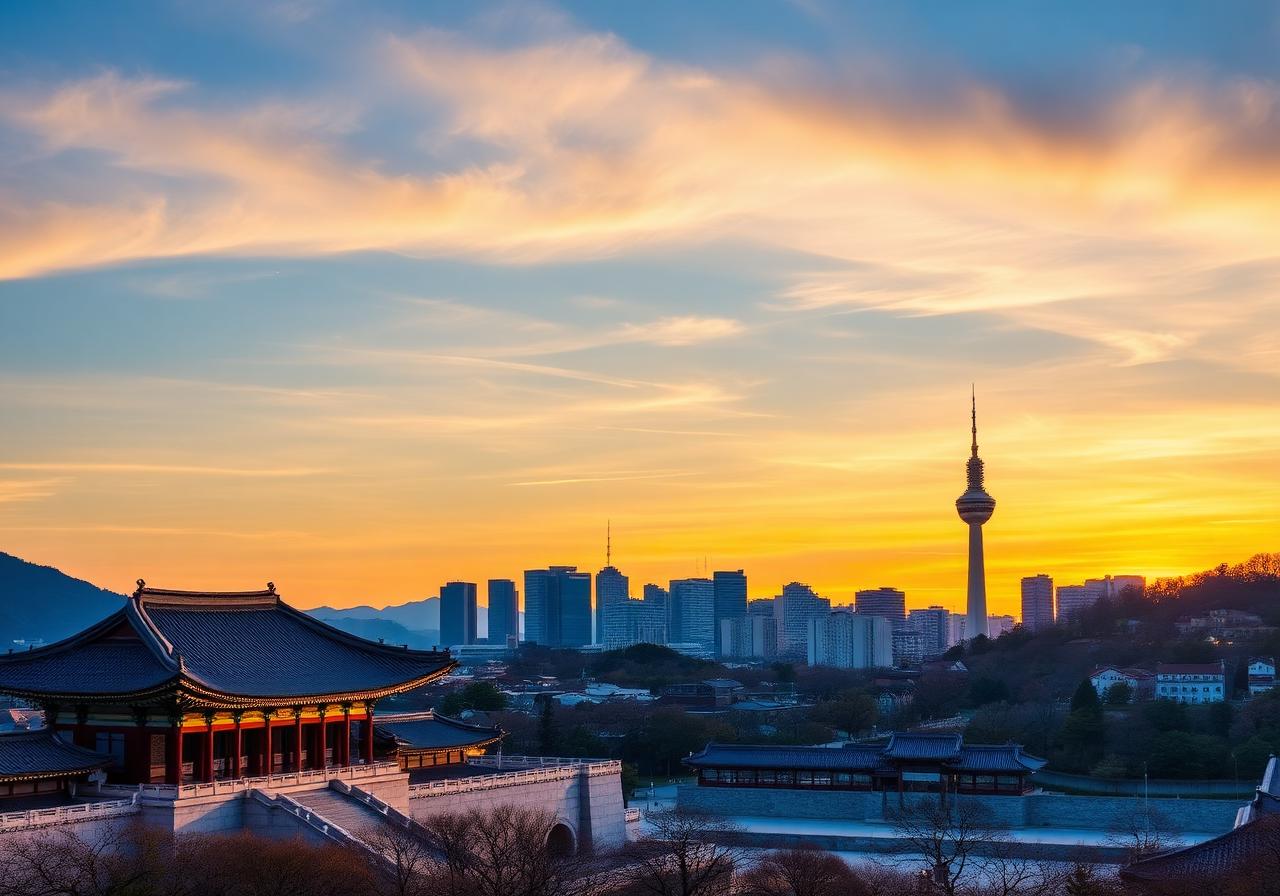
The limestone expanse of Seoul’s Gwanghwamun Square is a place defined by gravity. To the north, the granite peaks of Bukhansan provide a jagged backdrop for Gyeongbokgung Palace; to the south, the skyscraper-lined Sejong-daero funnels the frantic energy of the capital. In December, however, the weight of history softens. As the sun dips behind the Blue House and the temperature drops toward a biting minus ten, the grey plaza undergoes a metamorphosis. This is the Seoul Lantern Festival and Gwanghwamun Market, an event where the austere statues of Admiral Yi Sun-sin and King Sejong the Great are surrounded by a sea of glowing hanji paper and the scent of cinnamon-dusted hotteok.
The Art of Hanji and the Great King
The aesthetic soul of the market is the Seoul Lantern Festival, an exhibition of oversized sculptures crafted from traditional Korean paper. Unlike the mass-produced LED displays found in many global cities, these lanterns are meticulous works of folk art. Artisans stretch thin, fibrous hanji over wire frames to create glowing scenes of Joseon Dynasty life: scholars in horse-hair hats, court dancers in flowing hanbok, and mythical Haetae (lion-like guardians of the city) that appear to flicker with internal life.
The centerpiece is always the giant statue of King Sejong. During the market, he sits atop his bronze throne as the spiritual anchor of the festivities. Surrounding the monument, contemporary light installations bridge the gap between 1446 and 2024. One might find a fifteen-metre-tall Christmas tree illuminated with motifs from the Irworobongdo—the sun, moon, and five peaks painting that sat behind the king’s throne—standing mere yards from a whimsical, glowing carousel.
High-End Crafts and the Artisan Corridor
If a typical European market relies on wooden gnomes and factory-pressed baubles, Gwanghwamun leans into Seoul’s reputation for bespoke craftsmanship. The market stalls, designed as elegant white huts with pitched roofs, are curated to highlight local designers rather than mass importers.
Look for the stalls near the Sejong Center for the Performing Arts. Here, vendors like O-Sulloc offer refined tea sets, while independent ceramicists sell hand-thrown celadon mugs that keep fingers warm. The stationery on offer is a highlight; look for intricate letter sets printed on mulberry paper and woodblock charms featuring the "Seoul My Soul" branding. These are not mere trinkets but high-quality goods that reflect the "New Retro" trend—a Seoul-specific movement that translates ancient Korean motifs into sleek, modern accessories.
A Gastronomic Fusion of East and West
The air at Gwanghwamun smells of charred wood and sugar, a sensory byproduct of the "Food Zone" located near the Haechi Madang. While one can find mulled wine—locally known as vin chaud and often simmered with dried persimmons and jujubes—the true draw is the reimagined Korean street food.
The queues are longest for hotteok, a yeasted pancake filled with molten brown sugar and seeds, which at this market often comes with a dusting of roasted soybean powder to temper the sweetness. Do not miss the dakggochi (grilled chicken skewers) glazed in a spicy gochujang reduction, which provides a necessary heat against the Siberian winds whipping down the plaza. For something more substantial, vendors serve tteok-galbi (minced short rib patties) served on sticks, a dish that originated in the royal courts of the Joseon Dynasty and now functions as the ultimate luxury winter snack.
The Light of Cheonggyecheon
To experience the market in full, one must walk the few hundred yards to the mouth of the Cheonggyecheon Stream. This sunken waterway, which begins at the Cheonggye Plaza, serves as a subterranean extension of the market’s light display. While Gwanghwamun felt grand and ceremonial, the stream is intimate.
The water reflects hundreds of floating lotuses and LED bridges. The walk along the banks, beneath the street level of the city, offers a quiet reprieve from the crowds above. On the walls of the stream, digital artists often project "media facade" shows—abstract, high-definition animations that turn the cold concrete into a canvas of shifting colours. It is here that the European Christmas influence is most subtle, replaced by a pure focus on the Korean obsession with light as a symbol of hope for the New Year.
Performance and the Pulse of the Square
Gwanghwamun is rarely silent. Throughout the duration of the market, the main stage near the Admiral Yi Sun-sin fountain hosts a rotating schedule of performers. One might encounter a traditional Samulnori percussion troupe, their white ribbons spinning in dizzying arcs against the night sky, followed immediately by a K-Pop dance unit or a jazz trio performing carols in the style of 1950s Seoul.
The square is also home to interactive zones where visitors can try their hand at making their own hanji lanterns or participating in traditional games like tuho (arrow throwing). These activities are not tucked away in a corner; they are central to the experience, reinforcing the idea that Gwanghwamun is the "People’s Plaza." Even as the city modernises at breakneck speed, the winter market allows for a slow, tactile connection to the past.
If You Go
The Gwanghwamun Square Market and Seoul Lantern Festival typically run from mid-December through the first week of January. Lights are switched on at 6:00 PM and usually extinguished by 10:00 PM.
Transport: Take Line 5 of the Seoul Subway to Gwanghwamun Station (Exits 2, 3, 4, 7, or 9) or Line 3 to Gyeongbokgung Station. Dress: Temperatures often drop well below freezing; thermal layers (Uniqlo’s Heattech is the local uniform) and windproof coats are essential. Payment: Almost all vendors accept international credit cards (Visa/Mastercard) and T-Money cards, though carrying a small amount of cash is useful for smaller food stalls. Crowds: To avoid the heaviest foot traffic, visit on a Tuesday or Wednesday evening; Saturday nights are exceptionally busy with local families and couples.