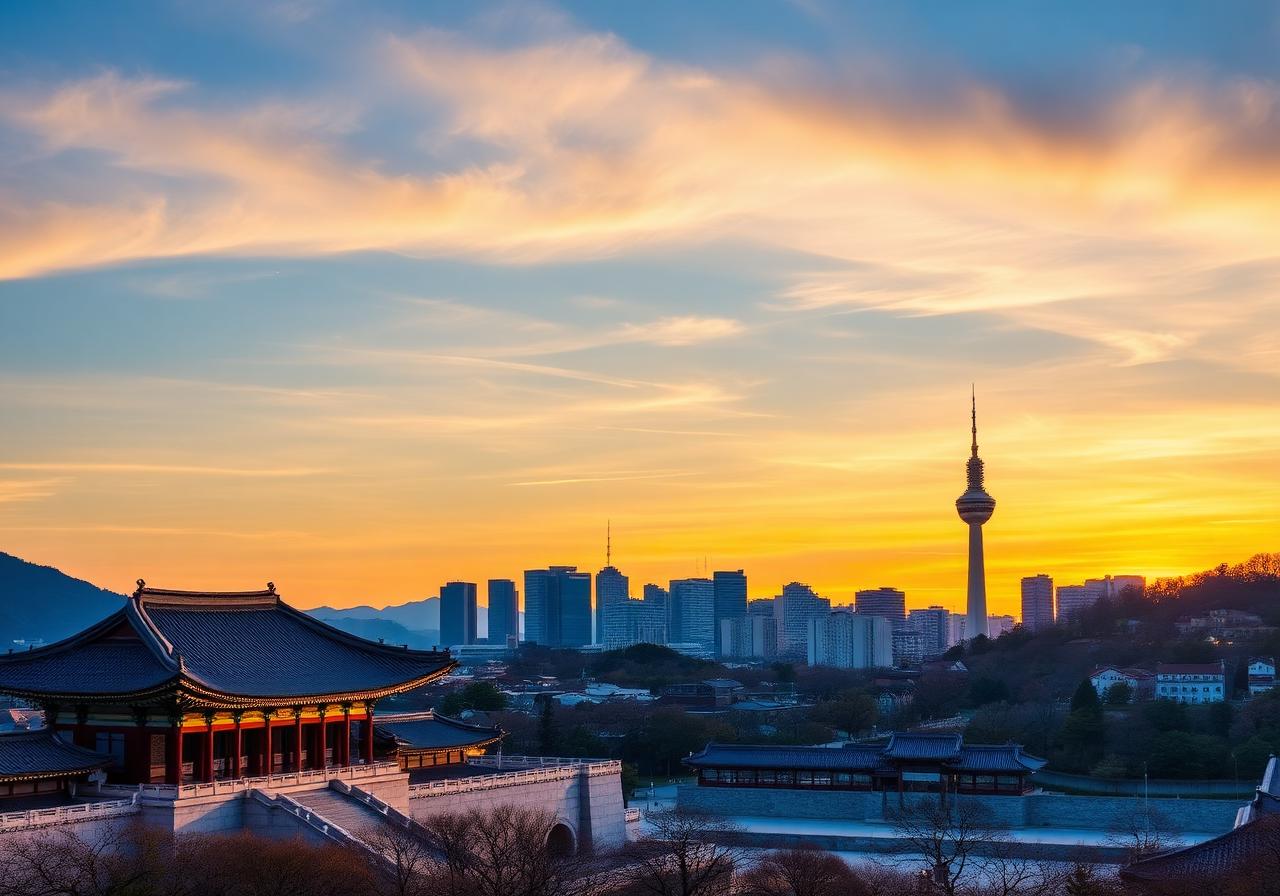
Gwanghwamun Square: A Joseon Dynasty Winter Wonderland
The cold snaps hard in a Seoul December. A dry, crystalline chill bites at your cheeks, the kind of cold that makes the glow of a light seem warmer, the steam from a paper cup of broth more fragrant. Here, on Gwanghwamun Square, the city’s grandest boulevard, something remarkable happens as the sun sets early behind Bugaksan mountain. The stern, ceremonial axis of the nation, a place of statues and stony history, melts into a sprawling winter festival. Beneath the benevolent bronze gaze of King Sejong the Great, the inventor of the Korean alphabet, a Christmas market unfolds that is entirely, thrillingly Seoul’s own. It is a spectacle not of Bavarian gingerbread houses, but of dynastic silhouettes and digital light, of spicy rice cakes and artisan ceramics.
The Royal Road Turns Radiant
Gwanghwamun Square is no mere plaza. It is the spine of Seoul, a 550-metre-long promenade stretching south from the main gate of Gyeongbokgung, the primary palace of the Joseon Dynasty. By day, it is a place of formal procession, of commuters scurrying towards the Government Complex, of tourists posing before the statue of the formidable Admiral Yi Sun-sin. But from mid-December, as part of the city-wide Seoul Winta Festival, this historic thoroughfare undergoes a complete metamorphosis.
What was once austere stone is now a pathway of pure light. The transformation is staggering. Thousands of LEDs form shimmering tunnels and celestial canopies overhead. The market itself, a collection of neat wooden chalets, lines the central reservation, creating a bazaar that feels both temporary and deeply rooted. To the north, the exquisitely bracketed roof of the Gwanghwamun gate provides an unrivalled historical backdrop, its shape thrown into dramatic relief. To the south, the glass towers of the central business district glitter like shards of ice. It is this collision of the ancient royal court and the hyper-modern metropolis that gives the market its singular character.
More Than Mulled Wine: A Taste of a Korean Winter
While you might find a stall selling a passable imitation of glühwein, to focus on it would be to miss the point entirely. The true joy of the Gwanghwamun market lies in its street food, the culinary arsenal against Korea’s formidable winter. The air is thick with the sweet, nutty aroma of hotteok. These are fluffy, yeasted pancakes, stuffed with a molten mixture of brown sugar, cinnamon, and chopped peanuts, then flattened on a hot, oiled griddle until the edges are crisp and the centre is chewy. Watching the vendor expertly flip one with a steel press is half the pleasure; eating it, folded into a paper cup to contain the searingly hot filling, is a rite of passage.
Follow the plumes of steam to find stalls selling eomuk, or fish cake skewers, bobbing gently in vast vats of savoury dashi-based broth. The vendor will hand you a skewer and a paper cup, which you can fill and refill with the warming, umami-rich soup – an essential hand-warmer. For something more substantial, seek out the deep crimson cauldrons of tteokbokki. These chewy, cylindrical rice cakes are braised in a fiery-sweet sauce made from gochujang (chilli paste), a dish that delivers a satisfying, heat-spreading punch. And everywhere, you will see people clutching bungeo-ppang, the iconic fish-shaped pastries filled with sweet red bean paste, their whimsical shape a comforting constant in the Seoul winter landscape.
Lanterns of Hanji, Crafts of Heart
The shopping here eschews the mass-produced baubles of lesser markets. The Seoul Metropolitan Government, which organises the event, uses it as a showcase for local designers and artisans. The result is a curated collection of high-quality goods that speak to a modern Korean aesthetic. You will find exquisite hand-painted ceramics, from delicate teacups to minimalist moon jars, some echoing the pale celadon glazes of the Goryeo period. Independent jewellery makers from neighbourhoods like Hongdae and Samcheong-dong sell their wares: think asymmetrical silver earrings or necklaces featuring subtle traditional motifs.
Dominating the visual landscape, however, are the lanterns. These are not simple paper globes. Crafted from hanji – traditional Korean paper made from the inner bark of the paper mulberry tree – they are large-scale, sculptural masterpieces. As part of the concurrent Seoul Lantern Festival, these installations depict everything from the animals of the East Asian zodiac to scenes from folk tales. A giant, glowing rabbit might hold court near a shimmering dragon, their colours deep and resonant thanks to the unique texture of the hanji paper. They transform the market from a simple shopping venue into a walkable gallery of luminous art.
The King and the Ice Rink
Presiding over the entire affair is the 20-metre-tall statue of King Sejong the Great. Seated on his throne, a book in his hand, he is the anchor of the square and, in many ways, of the Korean identity. The festive chaos that unfolds at his feet creates a wonderful, slightly surreal juxtaposition. The inventor of the Hangeul script, a sovereign from the 15th century, now watches over families taking selfies in a light tunnel and teenagers sipping bubble tea.
Just in front of his statue, a huge outdoor ice rink is installed for the winter season. The sound of skate blades scraping the ice and the cheerful playlist of K-pop hits—think BTS's 'Butter' or NewJeans' 'Hype Boy'—adds another layer of modern energy to the scene. Here, couples hold hands, children push plastic penguins, and the majestic backdrop of palace and mountain feels like a film set. The presence of these historical guardians—King Sejong and, further down the square, the armoured Admiral Yi Sun-sin—doesn’t feel stuffy or out of place. Instead, it grounds the celebration in a deep sense of place, a reminder that this holiday party is happening on sacred national ground.
Seoul Light Gwanghwamun
The market is inextricably linked with 'Seoul Light Gwanghwamun', a dazzling media art show that uses the city’s architecture as its canvas. As darkness falls, the vast, plain façades of the Sejong Centre for the Performing Arts and the National Museum of Korean Contemporary History, which flank the square, erupt into life. Gigantic projection mapping shows, synchronised to epic, orchestral soundtracks, tell stories of Seoul’s past, present, and future. Light beams criss-cross the sky, and for 15 minutes, all eyes turn from the market stalls to the buildings themselves. These shows often begin on the hour after 6 PM, and it is well worth timing your snack run to be in a good viewing position when the lights dim and the spectacle begins. It is an ambitious, high-tech display that reinforces Seoul’s status as a capital of digital innovation, a perfect, futuristic counterpoint to the traditional crafts in the market below.
If you go
Getting There: Seoul's public transport is superb. Take Metro Line 5 to Gwanghwamun Station (Exit 9 is directly on the square) or Line 3 to Gyeongbokgung Station (Exit 5).
Dates and Times: The Gwanghwamun Square Market typically runs from mid-December until the end of January. Hours are generally 6 PM to 10 PM daily. Dates and times are subject to change, so always check the official Seoul Metropolitan Government or Visit Seoul website before you visit.
What to Wear: Seriously warm clothing is essential. Seoul winters are dry but frigid, with temperatures often dropping well below freezing. Layering is key: a thermal base layer, a fleece or wool jumper, and a well-insulated, windproof coat. A hat, gloves, and a scarf are absolutely mandatory.
Money: Most vendors in the chalets accept credit cards, but it is always wise to carry some Korean won in cash for the smaller food stalls.
Pro Tip: Combine your evening market visit with an afternoon exploring nearby Insadong for its traditional tea houses and craft shops, or spend the day at Gyeongbokgung Palace (it closes before the market opens) to fully appreciate the historical context of the location. Weekday evenings are significantly less crowded than weekends.