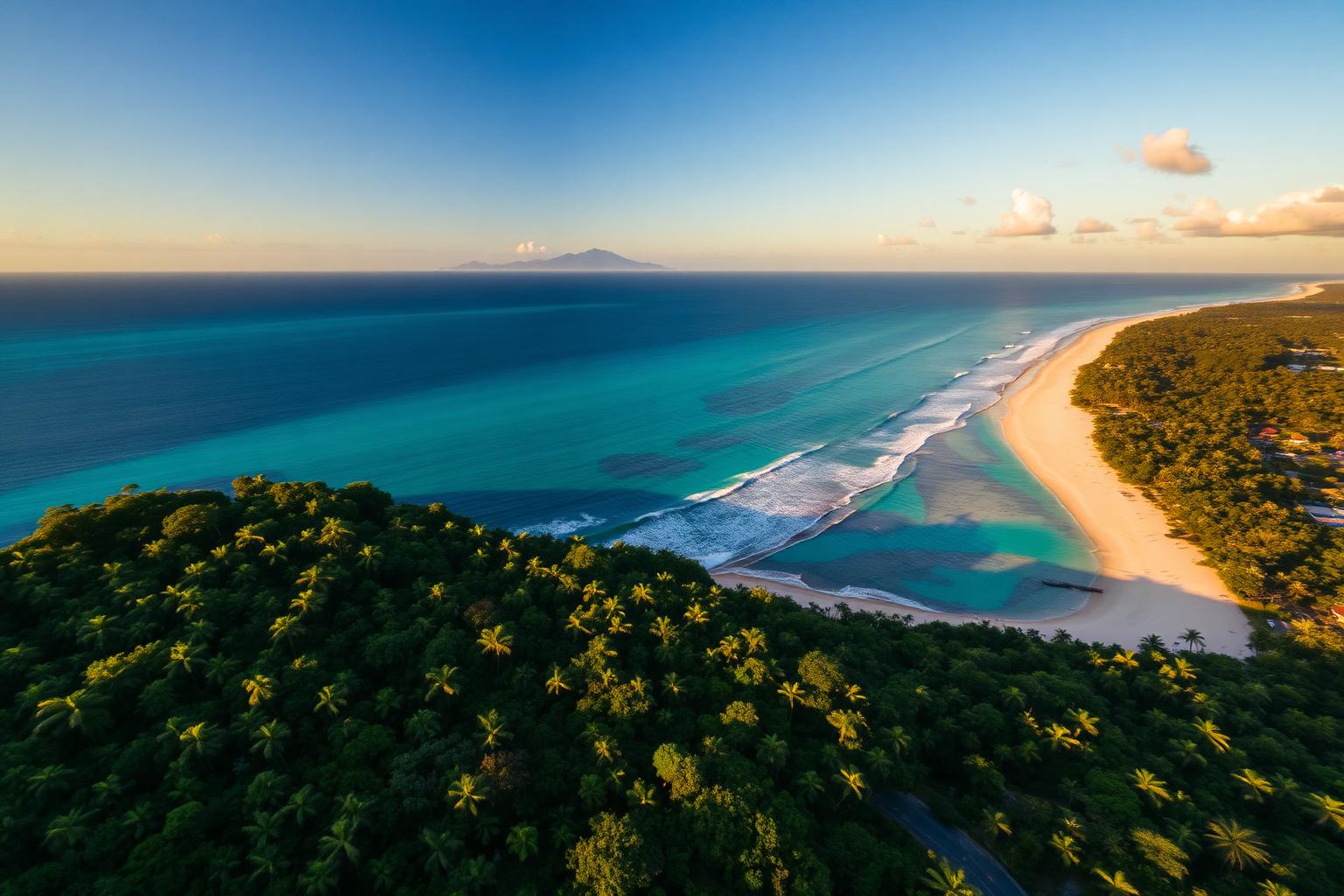
The heat in Cairns is not merely a temperature; it is a weight. In the Edge Hill district, four kilometres north of the city centre, this humidity serves a specific biological purpose. It sustains a canopy so dense it swallows the tropical sun, creating a microclimate where time appears to have stalled in the Gondwanan era. To enter Flecker Garden is to step away from the modern Queensland coast and into a landscape of primitive ferns, cyads, and gargantuan 'flesh-eating' pitchers that have remained largely unchanged for 400 million years.
The Wollemi Pine: A Living Ghost
The undisputed sovereign of this collection is the Wollemi Pine (Wollemia nobilis). Until 1994, this species was known only through fossil records dating back 200 million years; it was presumed extinct for millennia before a small grove was discovered in a secluded canyon in New South Wales. In Flecker Garden, the 'Green Dino' stands as a botanical miracle.
Its bark resembles bubbling chocolate or charred cereal, and its pendulous, lime-green foliage feels alien to the touch. This is not a tree shaped by modern aesthetics but by the necessity of surviving an era of tectonic shifts and megafauna. Positioned near the garden’s main entrance on Collins Avenue, it serves as a silent reminder that the flora here predates the existence of the Great Barrier Reef by millions of years.
The Carnivorous Theatre of the Conservatory
Beyond the open-air walking paths lies the Watkins Isabelle Conservatory, a climate-controlled glass structure designed to house the delicate and the deadly. Here, the air grows thick with the scent of damp earth and rotting sugar. The collection focuses heavily on Nepenthes, the tropical pitcher plants.
These are not the subtle traps of a Venus Flytrap. Species like the Nepenthes mirabilis—the common swamp pitcher—grow as pendulous, waxy vessels filled with digestive enzymes. In the high humidity of the conservatory, these urns can grow large enough to drown insects and small frogs. Observe the intricate 'peristome' or the rim of the pitcher; it is often striped with deep crimson to mimic the appearance of raw protein, luring prey into a slick, inescapable pit. It is evolution at its most ruthless, a survival strategy perfected in the nutrient-poor soils of the prehistoric tropics.
Scent and Shadow: The Queen of the Night
Architecture in Flecker Garden is provided by the palms and the epiphytes. The Licuala walk, shaded by the massive, fan-like leaves of the Licuala ramsayi, creates a vaulted ceiling of green that filters the light into dusty shafts. Within these shadows, the garden hides its most intoxicating resident: the Selenicereus grandiflorus, commonly known as the Queen of the Night.
This cactus is a specialist in drama. It blooms only once a year, always at night, unfolding massive white petals that release a heavy, vanilla-infused fragrance designed to attract nocturnal pollinators like hawk moths. While the peak bloom usually occurs between November and December, the tangled, snake-like vines of the cactus remain a permanent fixture, scaling the trunks of rainforest giants. To see it in flower requires luck and a late-evening stroll along the periphery of the gardens, where the scent often hits the street before the flower is even visible.
The Primitive Undergrowth of the Gondwanan Heritage Garden
While the main garden is a showcase of beauty, the adjacent Gondwanan Heritage Garden is a masterclass in evolutionary biology. This section is structured as a chronological walk through the history of plants, starting from the earliest land colonists—mosses and liverworts—and moving through to the emergence of flowering species.
The cycad collection here is particularly significant. These palm-lookalikes, such as the Cycas media, are woody plants that produce cones rather than flowers. They were a primary food source for herbivorous dinosaurs. In the stillness of the Edge Hill afternoon, standing among these stiff, architectural fronds, the lack of birdsong (often replaced by the rhythmic clicking of cicadas) enhances the sense of being in a pre-avian world. The garden meticulously labels each stage of development, allowing visitors to trace the moment plants developed the ability to produce seeds, a Victorian-era dream of scientific categorisation brought to life in the tropics.
Culinary Respite at the Wild Orchid
No visit to Flecker is complete without acknowledging the human history of the district. Edge Hill is Cairns’ oldest suburb, and the gardens reflect a time when botanical exploration was a matter of empire and discovery. The Wild Orchid 73 cafe, situated just outside the garden gates on Collins Avenue, provides a contemporary contrast to the ancient forest.
A plate of salt and pepper calamari or a bowl of laksa here is best paired with a view of the towering African Mahogany trees that line the street. These giants were planted in the early 20th century and now form a cathedral-like archway over the bitumen. It is here that the modern world and the Jurassic fringe meet, as brush turkeys—modern-day descendants of the dinosaurs—boldly forage around the tables for crumbs.
If You Go
The Flecker Garden is part of the Cairns Botanic Gardens on Collins Avenue, Edge Hill. Entry is free, and the gates are open daily from 7:30 am to 5:30 pm. To avoid the worst of the tropical heat, arrive at opening time. The 131 bus runs regularly from the Cairns City Mall to Edge Hill.
For the most immersive experience, walk the Red Arrow Circuit nearby for a workout, then descend into the gardens for the cooling shade. Wear insect repellent; the prehistoric atmosphere extends to the local mosquito population, which is as persistent as the flora is ancient. Use the provided maps to locate the Wollemi Pine near the entrance, as its understated appearance belies its immense historical value.