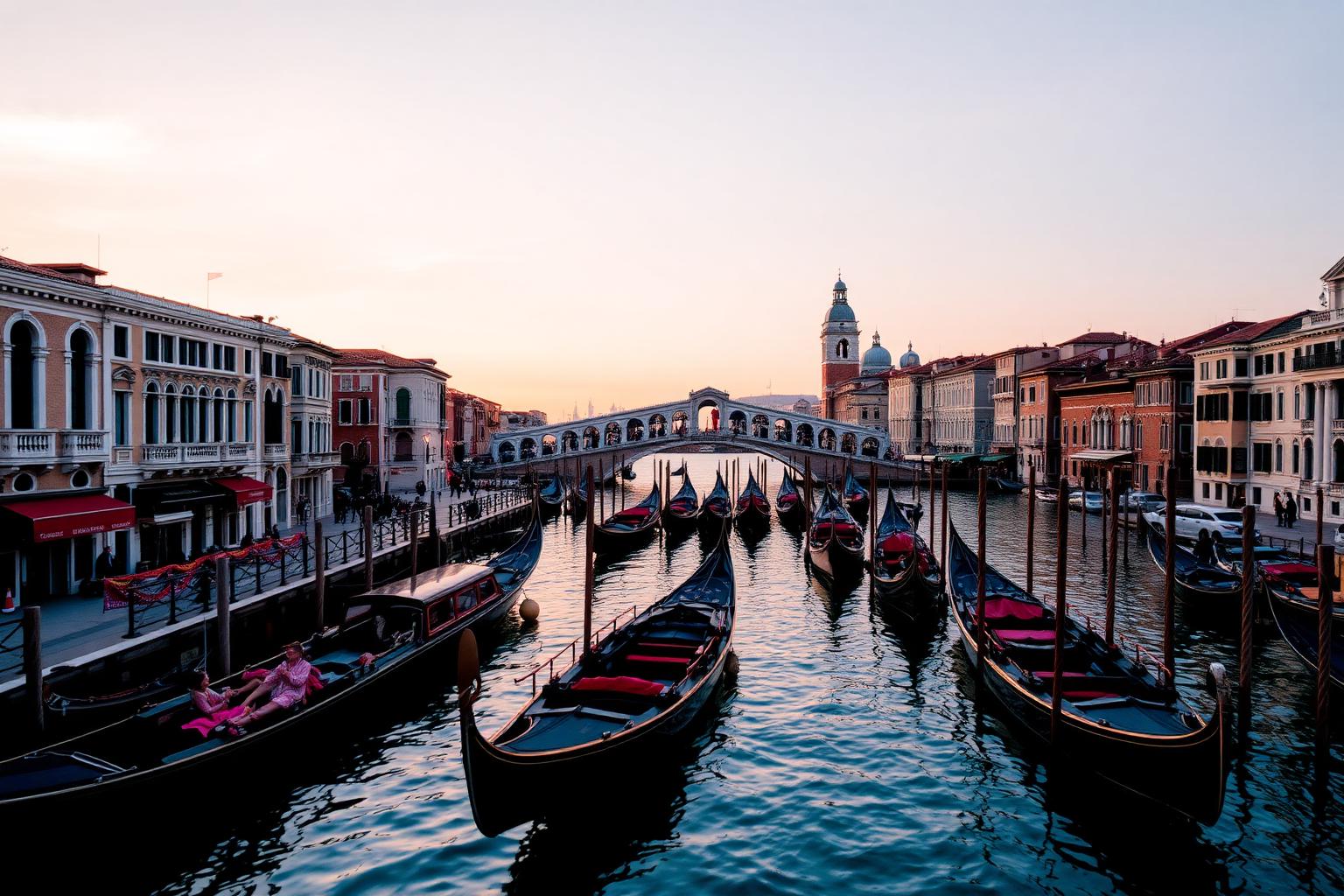
Beyond the perfume of rotting timber and the clatter of suitcases on the Ponte degli Scalzi, Venice hides a version of itself that refuses to participate in the postcard industry. While the crowds bottleneck at the Rialto for mass-produced glass and polyester carnival masks, a disparate tribe of collectors and out-of-towners migrates toward the city’s northern fringes. Here, in the shadows of the decommissioned industrial skeletons of Cannaregio, the air smells of mothballs and old paper rather than salt spray. This is the domain of the mercatini—the vast, chaotic second-hand warehouses where the sleek, neon-soaked aesthetics of 1970s and 80s Italy come to rest.
The Archival Allure of Cannaregio
Most visitors treat Cannaregio as a mere corridor to the train station, yet the further one pushes toward the Fondamenta Nove, the more the city sheds its Renaissance skin. This district remains one of the last bastions of actual Venetian life, and its thrift stores reflect a domestic reality rather than a tourist fantasy. Unlike the manicured vintage boutiques of Milan, the warehouses here, such as the sprawling Mercatino dell’Usato di Venezia, operate on a logic of serendipity.
Racks are jammed with heavy wool loden coats from the mainland and stiff, boxy suits that look as if they were plucked from the set of a Poliziotteschi crime thriller. To navigate these aisles is to trace the history of Italian manufacturing before the era of globalisation took hold. You aren’t just looking for clothes; you are looking for the tactile remnants of a disappearing middle-class elegance—the "Made in Italy" tag when it actually meant a workshop in the Veneto rather than a factory in a distant province.
Hunting the Paninari Aesthetic
To understand the gold mine within these limestone walls, one must understand the Paninari. In the early 1980s, this Milanese youth subculture rejected the political grit of the 70s in favour of American-inspired consumerism and luxury sportswear. They rode mopeds, hung out at sandwich bars, and wore a very specific uniform: Moncler puffer jackets, Timberland boots, and Best Company sweatshirts.
In the back corners of Cannaregio’s thrift depots, these relics frequently resurface. It is not uncommon to find a deadstock Best Company crewneck designed by Olmes Carretti, identifiable by its intricate embroidery of ducks or alpine landscapes. These aren't just jumpers; they are the artefacts of Italy’s first true obsession with streetwear. Finding a pristine, high-shine puffer jacket from this era—typically in a jarring shade of electric blue or Ferrari red—is the ultimate prize for those who find the standard Venetian aesthetic too muted.
Fiorucci and the Graphics of Pop Italy
If the clothes provide the texture, the ephemera provides the soul. Elio Fiorucci’s influence on Italian culture in the 70s cannot be overstated; he brought the anarchy of Studio 54 to the streets of Milan and Venice. At shops like L’Armadio di Coco, the curation is tighter, leaning into the graphic boldness of the era.
Collectors often dig through crates of old magazines and loose prints to find original Fiorucci posters—those unmistakable cherubs with sunglasses or pin-up girls in Day-Glo palettes. These items represent a time when Italian design broke away from traditionalism to embrace something kitsch, plastic, and unrepentantly loud. It is a sharp contrast to the Gothic arches of the surrounding city, a reminder that Venice was a place of radical modernity long before it became a museum.
The Ritual of the Scavenge
The true Venetian thrift experience requires a specific temperament. The Mercatino at the foot of the Ponte della Libertà is a cathedral of the discarded. One might find a pile of Murano glass ashtrays from the 1960s—heavy, sommerso-style blocks of amber and violet—sitting atop a stack of 1970s Casabella architecture journals.
There is a distinct lack of ego in these spaces. The staff rarely know the "Grailed" value of a specific Stone Island piece or a pair of vintage Carrera shades. Success depends on the ability to see past the dust. A rummage through the accessory bins can yield silk scarves from the 1970s with hand-rolled edges, or leather belts with massive, sculptural brass buckles that scream of 1978 Rome. The joy lies in the disconnect: buying a piece of high-octane, mainland Italian cool within a city that is literally sinking into the ancient mud.
From the Warehouse to the Calle
After the hunt, the transition back to the Venetian streets feels different. Dressed in a newly acquired oversized wool blazer or a corduroy shirt from a defunct Mestre tailor, the city’s high-fashion boutiques—the Pradas and Guccis near San Marco—feel strangely hollow. The thrift culture of Cannaregio offers a connection to the people who lived here when the city was a functioning port, not just a backdrop.
Walking down the Calle del Forno, away from the warehouses, one might spot a local nonno wearing the exact same silhouette found on the racks. This is the "Mainland Style"—practical, durable, yet cut with a sharp Italian eye for proportion. It is a style that ignores the cruise ship crowds and looks instead toward the industrial horizon of Marghera. In these quiet corners, the 1970s never really ended; they just got tucked away in a warehouse, waiting for someone to find the right hanger.
If you go
Mercatino dell’Usato di Venezia: Located on Via della Libertà, this is the primary destination for bulk scouting. It is a short bus or vaporetto ride from the historic centre. Check the opening hours religiously; many close for a long lunch (riposo) between 12:30 and 15:30.
L’Armadio di Coco: Situated in Cannaregio, this boutique offers a more curated selection of high-end vintage. Expect to find more recognisable labels like Missoni, Roberta di Camerino, and early Armani.
Practical Tip: Bring cash. While the larger warehouses accept cards, the smaller stalls and independent vendors often prefer "moneta." Bring a sturdy tote bag; you will not find plastic carriers here, and a heavy 80s leather jacket is a difficult thing to carry by hand across five bridges.